Saturday, 16 November 2013

Startups and Upstarts in ‘Silicon Allee’

Notes of a Professional Event Photographer in Berlin


Berlin has been called multi-kulti, poor but sexy, the ever-changing city and most recently, Silicon Allee—due to the increasing number of tech startup companies moving into the Bear Pit.  Rents are relatively cheap—though steadily rising, as creative types and startup geeks continue to flock to Germany’s culture capital to stake their claims on the future.


Some of the more clever event planners have taken full advantage of Berlin’s ever changing city status to host tech events in art parks and open spaces in addition to the tried-and-true hotel conference halls.


The Tech Growth Summit in Berlin was one such event.  Innovators, inventors and investors all met in Berlin recently to throw their hats in the Silicon Allee ring.  The opening dinner reception was held at Urban Spree Gallery in the East Berlin neighborhood of Friedrichshain—a popular art/club colony sculpted out of some of the industrial rubble and rust of the former DDR East Berlin.  Urban Spree Gallery often hosts the latest work by up and coming Berlin street artists and urban sprayers.

The group team building exercise for the evening:  spray can graffiti competition. It was a nice change of pace from the typical event meeting to watch executives don overalls and masks, shake their spray cans and go to town on some blank walls in the open air garden.

The Big Day of the Tech Growth Summit commenced the day after in two equally exciting venues:  a refurbished, former electrical power plant in Berlin-Kreuzberg and the closed historical airport Berlin Tempelhof.  If nothing else, Berlin is the master of pulling trends out of detritus:  a swanky, modern interior with leather lounge couches filled the floors under the vaulted brick heights of an open former factory hall and wrought iron stairs ascended over fountains spewing bubbling jets of red-lit water.

Later in the day after the convention adjourned, we traveled to the former site of the Berlin Airlift, Flughafen Berlin-Tempelhof (Tempelhof Airport, Berlin). Conventioneers consumed cocktails in the massive open space of the departure hall. Cocktail waitresses in vintage airline stewardess outfits shook their shakers at check in counters under the signage of various living-and-dead airlines, while suave barmen shoved crates of booze and glasses through the luggage conveyor belts to the waiting bar staff.


Cornelia Barbara Yzer, Senator for Economics, Technology and Research, Berlin, addressed the crowd of visiting foreign e movers and tech shakers.  Her message was clear: come to Berlin.  The doors are wide open and the forecast was mostly sunny—though I managed to pick out a parenthetical warning from one of the other speakers: let’s not make another bubble economy like Ireland or others who are still reeling from the fish-and-cut-bait methods of less-than-scrupulous investors in the last decade. Working together, they said, we could all build an economy that works for everyone involved.


And on that note, I grabbed a drink from the check in counter and raised it.


Tuesday, 29 October 2013

Berliner Brains Buffet

The Berlin Zombie Walk 2013


A flash mob of dozens of costumed 'zombies' shambled through the streets of Berlin on Saturday, October 26, 2013.  This was the latest outbreak in a growing global 'infection' of Zombie Walks in various cities all over the earth.

Everyone loves a big, juicy zombie.  With a plethora of zombie films and television shows topping the entertainment charts, the undead may one day knock King Vampire out of the horror throne.  I've personally loved zombies as long as I can remember; the first zombie film I recall watching was the 1979 Italian made ‘Zombie.’   I was around 14 when I saw the film and I gazed in wide-eyed wonder at the blood, rot, gore and bouncing breasts displayed throughout the film.  I was probably too young to see the bouncing breasts as an American.  The blood and guts?  No problem.  Americans are weaned from milk to blood.


One of the first zombie walks ever recorded was put on by my Sacramento hometown pals at TrashFilm Orgy in 2001.  I’m from Sacramento, grew up there, and worked with my horror film friends on 8mm black and white home movies.  So when the first Sacramento zombie walk began—sadly, I wasn’t there to see it.  I lived in Prague at the time.  So this year I was extremely thrilled that a zombie walk was finally taking place in a city where I actually reside:  Berlin.

On a clear night at dusk, the Berliner zombies met outside the Gothic ruins of Klosterkirche and shambled through the streets to finally invade Alexanderplatz and strike terror and joy in equal parts to anyone who happened to be in their path. At various intervals in the terror schedule, several zombies danced a choreographed routine to the music of Michael Jackson’s ‘Thriller.’


The range of costume creativity was as diverse as the zombie figure itself:  some of the zombie walkers had white faces with yellow eyes and bloody mouths; others had gray faces with black circles around the eyes.  One tech geek zombie had a bloody hole in his shirt and a mass of wriggling worms moving within.  I looked at my photographer friend and said ‘That’s probably a smart phone app of some kind.’


These are only a few of the many photos I took while stumbling, shuffling and shambling along with the Berliner zombie horde on Saturday night.  Please don’t hesitate to visit my website and contact me for your next photography or zombography project in BerlinPrague or beyond…

Thursday, 20 June 2013

Berlin Street Art Portrait Shoot


Once in a while, not very often, someone asks me if I have a studio in which to take portraits.  I resist the urge to say GOOD GOD, WHY? and simply say that Europe is my studio.  For people who don't want the tired, trite and tedious fast food studio session photography, I offer my unique style of artistic location portraits in Berlin, Prague and beyond.

Berlin's vibrant street art scene adds the perfect splash of color to any portrait shoot.  The East Side Gallery section of the Berlin Wall monument is one of my favorite locations--miles of murals and swirls of spray can art are everywhere.


Viktoria wanted artistic, creative portraits with Berlin as a backdrop.  We chose the East Side Gallery and nearby YAAM riverside beach bar and club as our stomping grounds.  The people at YAAM were very friendly and helpful in letting us use their facilities for photography.  This warm feeling allows for more relaxed, natural portraits.


For more information on booking your portrait photography in Berlin please contact me
I look forward to working with you!

Tuesday, 2 April 2013

The Great Gig in the Sky


Your Private Event Photographer in Der Himmel Über Berlin


The glass walls of Berlin's Puro Sky Lounge in the Europa Center afford a stunning panoramic view of Berlin at night.  I was hired to be the party photographer for a group of friends and business associates who were leaving Berlin.


As a photographer, I scoped out the shots that I would get for the evening; most of which revolved around the idea of people standing near the glass and looking out at the glittering skyline of Berlin. After a while it seemed nobody was willing to stand by the glass—most of them seemed clustered around the bar.  This is fully understandable.  Perhaps some people were afraid of heights—you really are looking through a glass wall 21 stories straight down.  Or maybe they simply found more comfort within shouting distance of the bartenders.

A magician appeared with a deck of cards.  No hat, no rabbit, no smell of Vaudeville anywhere on this guy.  The prestidigitator rolled up his sleeves, shrugged, shuffled his magic cards and pulled objects out the air, people’s hands, their pockets, their wallets and their purses.  People shouted and laughed in disbelief, some of them crying ‘That is SCARY!’ at the surprise ending of each fascinating trick.

The ever-present Berlin dj figure eventually gave way to the live band Brooklyn Bridge, a rock/soul/blues cover band.  After warming up the crowd with the tried and true R & B radio hits of the 70s and 80s, the band started to funk it up a notch.  As the first slow wave of shaking booties began to get the party started, I switched into my ambient slow mo mode.  This is also the only way to preserve the dim, colorful ambient lighting of the near-dark club.  It also yields some great shots of both the guests and the vivid colors of the Berlin city lights at night.  Long exposures + flash = vibrant colors in motion.


I am available for private and corporate events and parties in Berlin, Germany and Prague, Czech Republic.  Please feel free to view my event photo gallery and don’t hesitate to contact me for a price quote on your next event in Berlin and beyond…

Wednesday, 6 March 2013

Berlin Sells the Berlin Wall to Developers


On March 1st Berlin sold a piece of its culture and history to the highest bidder.  And the crowd went wild.  On the streets along the East Side Gallery, the longest remaining stretch of the Berlin Wall and open air gallery, hundreds gathered in protest of the cultural rape.  City honchos and district bosses simply shook their heads and stated that the new owners had the right to destroy the second biggest tourist attraction in Berlin.


How an officially-marked Berlin denkmal (monument) could be sold without public involvement is a scandal of the highest order.  Construction crews removed the first section under cover of night, but by 9am Friday morning, hundreds had gotten wind of the change.  You just can’t hide a giant crane lifting a brightly colored, 12 foot concrete slab in the air.


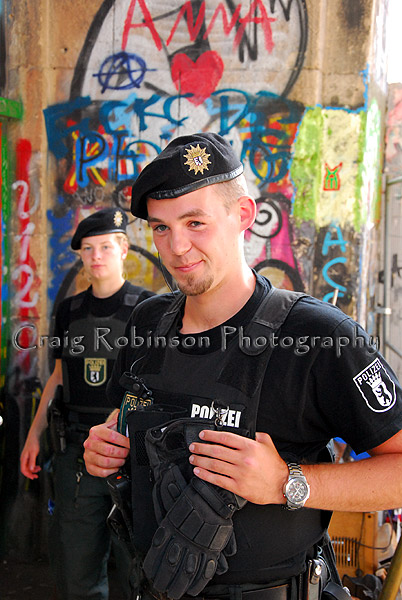
Police gathered in force:  at first only a few dozen ‘garden variety’ officers formed a human wall and taped protestors off across the street from the Wall.  When push came to shove, a gang of riot police quietly sidled into position and dropped a metal barricade between the construction site and the crowd—but not before the entire group broke through the police tape and wheeled a mock section of the Wall right through the police lines.  The wall segment read ‘Mr. Obama.  Tear Down Wall Street,’ a reference to Ronald Reagan’s famous statement at the original Berlin Wall: ‘Mr.Gorbachev. Tear down this wall.’

In the end, protestors' efforts were not in vain.  Police informed the crowd over bullhorns that the wall destruction would be delayed--for now...


Saturday, 15 December 2012

Dennis Hopper: The Lost Album


A Photo Exhibition at Martin-Gropius-Bau, Berlin
20 September to 19 December 2012


Dennis Hopper was a photographer for several years before his creative trajectory was forever altered by the roaring cult film engines of Easy Rider.  In one quote on the wall of the Martin-Gropius-Bau gallery, Hopper explained that he ‘took photographs to fill the void inside of him’ during his formative years.  After that he ‘never picked up a camera again.’

Crates of Hopper’s photographic prints were discovered after his death. He was either preparing for a retrospective exhibition on the 60s—when all of his photos were taken—or someone saw a chance to make some posthumous pennies.  All of the photographs on view were a very small 7x10” (as if carried around with him in a portfolio) and yellowed and browned with age.  The effect is meant to give the photos a museum quality, but I found the size and discoloration distracting for the most part.  Unless he had printed them all himself by hand, there is no reason why some assistant couldn’t have provided us larger, sharper prints to view.

The man and the era were the stars of the show.  With the exception of a few strong images of iconic figures like Martin Luther King, Jr. (pushed to the right of the frame by a sea of microphones, perhaps suggesting The Black Voice being heard for the first time) and some portraits of Andy Warhol (without his usual blond fright wig) and The Factory artists and some great shots of Hell’s Angels, the collection struck me as largely a student’s portfolio. Regardless of the time needed to master the technical aspects of black and white photography, many additional years are required to even begin to master what Henri Cartier-Bresson called ‘the decisive moment.’  Hopper’s portraits have the boon of the 60s zeitgeist and the man’s cult status behind them.  However, many of the shots wouldn’t stand on their own as works of art.

The lost crates were stuffed with images of several unrelated themes:  the 60s in New York and Los Angeles, Mexico and various abstract shots of objects.  Among these, only a few dozen struck my eye as having any great artistic merit other than being unrelated photo studies made by someone famous.  Walls filled with shots of old peeling posters, paint and rusty metal only reminds me of what most photographers shoot in their first five years.  You want to show EVERYTHING and damn the consequences.  But the true art of photography is in synchronizing the tool, the psychology of the moving human subject and the vision inside of the photographer.  This often requires a lifetime of study, dedication, observation and patience.

I don’t want to minimize the importance of the 60s as a society-shaping era, nor do I want to criticize the images solely on technique or execution.  Dennis Hopper was both a product of, a participant in and a partial documentarian of the turbulent 60s.  Simply by being Dennis Hopper, he had access to artists, celebrities, outlaws and counter culture iconoclasts which very few others could have managed to photograph.  His portraits of artists and celebrities are the most successful due to this relaxed familiarity.  It enabled Hopper to capture legends in repose.

Thursday, 8 November 2012

Kunsthaus Tacheles: A Requiem


A Berlin Icon swept under
carpet bombing banks;
gentrifying Gestapo
stuck the jack boot in.


Kunsthaus Tacheles (Art house Tacheles) was on the tourist map and guides once took merry tourists through the hallowed halls of art and piss-reeking stairwells to catch a glimpse of the Real Berlin.  The building survived Nazis, commies and squatters.  Now it is gone.

It has been months since the police pushed the last artists out of the former-art-squat-turned- artist-residence and the last angry shouts of protest fell on the deaf ears of press and passersby.  Tacheles died a slow death, fighting tooth and nail, as most alternative spaces do, until the very banks and investors who let them stay for a song ripped the rug out from under the very people who made the neighborhood as prosperous as it is today.  Looking up and down the restaurant and bar-lined street, there is no question that this is a bustling area.

Unchecked and unregulated, the uber-Capitalist machine runs roughshod over the very people who build communities and make neighborhoods worth living in.  But no, we must let laissez faire markets kick lazy fairy artists out into the street.  Because that’s what we do in the free world. 
I watched police moving the artists out.  I spoke to the artists and the police.  I took some photos as well.  These are just a few of the photos I took in what may later become a long term documentary of the effects of gentrification on city and citizen alike.